By Rachel Taylor MSc(Hons), biochemist and analytical chemist, and Luke Taylor PGDip SpSciHP, performance scientist. Co-founders of Taylored Health.
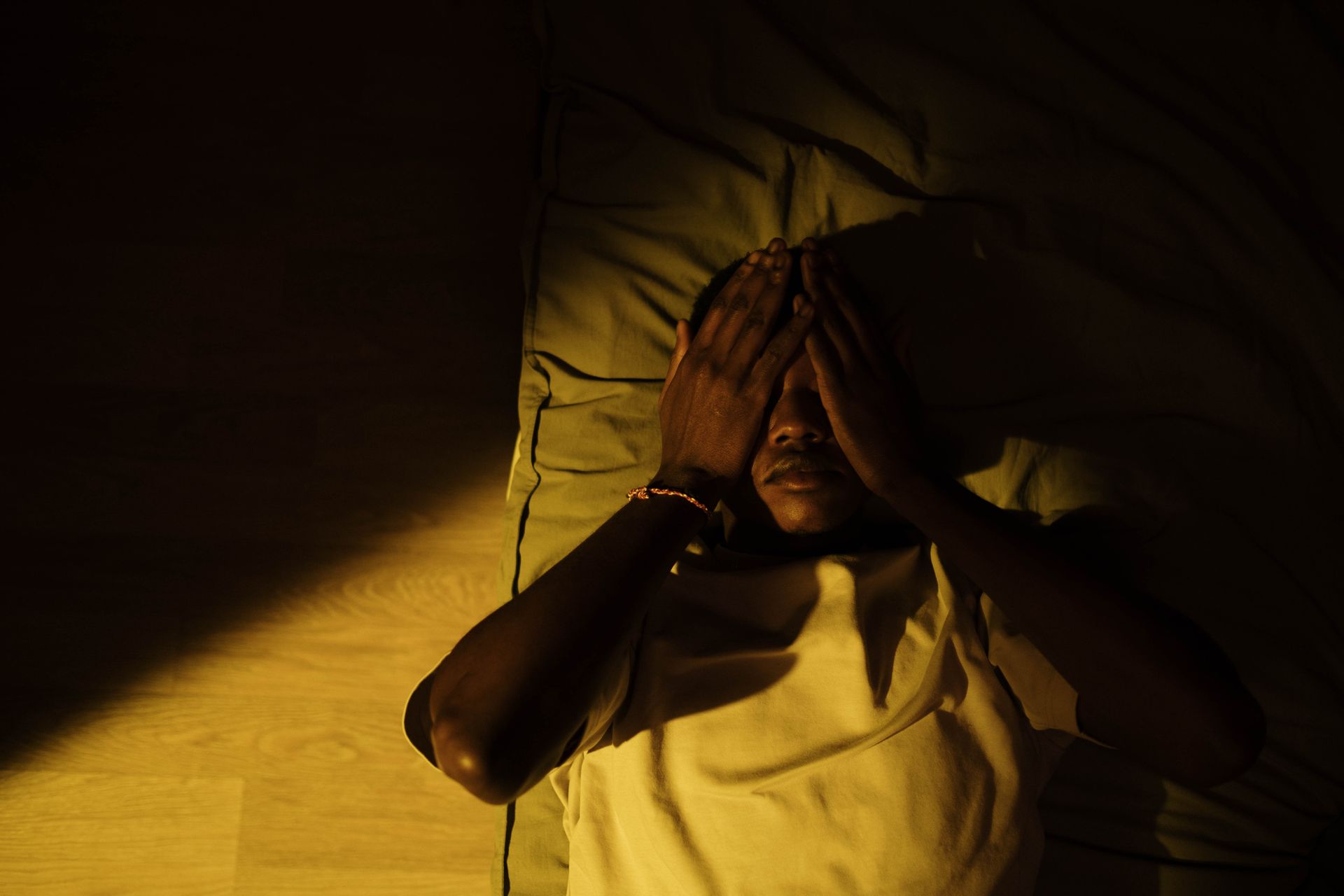
It’s 3am. The house is quiet and you’re wide awake. Your mind has already moved on to tomorrow’s meeting, last quarter’s numbers and a conversation from two years ago. You know you need the sleep, and knowing that makes it harder.
This is common, and it has a season. In Australia, searches for “can’t sleep” peak between 22 and 29 December, and they have done so every year for the last three years. Searches for insomnia peak again around 10 to 12 January, the week most people return to work (Google Trends).
We’re Rachel and Luke, the two scientists behind Taylored Health. We work with founders and executives in New Zealand and Australia, and broken sleep comes up with almost every one of them. This page explains what is happening in your body at 3am, and what to do about it.
Why do I wake up at 3am?
There are two reasons. 3am is the point in the night when your body is easiest to wake. And a body under sustained stress is closer to waking than a calm one.
Sleep isn’t one long, even stretch. You move through cycles of roughly 90 minutes, from light sleep down into deep sleep, then up into dreaming sleep (REM), and around again. Most people wake briefly between cycles several times a night and never remember it.
The cycles change as the night goes on. Most of your deep sleep happens in the first few hours. By 3am, most of it is done. The rest of the night is lighter sleep and dreaming, which are much easier to wake from.
Three other things are shifting at the same time.
Your sleep pressure has dropped. While you’re awake, a chemical called adenosine builds up in your brain. It is what makes you feel sleepy at night. Sleep clears it. By 3am you have cleared much of it, so there is less pulling you back under.
Your stress hormone is starting to rise. Cortisol is at its lowest around the start of the night. In the second half of the night it begins to climb, preparing you to wake in the morning. That is normal and healthy. In someone who has carried high stress for months, it can tip a light sleeper into being fully awake.
Your body temperature is near its lowest. It falls through the night and begins to rise again in the early morning, another signal that the body is preparing for the day.
So at 3am you are in light sleep, with less pressure holding you asleep and the morning signals starting up. Most people pass through this without noticing. In a body that has been on high alert for weeks, it is often enough to wake you fully.
Why does my mind start racing the moment I wake?
Waking briefly is normal. The racing mind is what keeps you awake.
Your nervous system has two main settings. One is the accelerator, the fight or flight side (the sympathetic nervous system). It speeds up your heart, sharpens your attention and readies you to act. The other is the brake, the rest and repair side (the parasympathetic nervous system). It slows your heart and lets the body recover. Sleep needs the brake.
When you have been under pressure for weeks or months, the accelerator can stay partly pressed, even at night. So when you surface at 3am, your body is already primed. Your brain looks for a reason, and it finds one quickly. The board meeting. The cash flow. The hire that didn’t work out.
There is a second reason those thoughts feel so heavy. The front part of your brain, the part that puts problems in proportion and makes plans, is less active in the middle of the night. The parts that scan for threat are still switched on. A problem that would feel manageable at 10am can feel enormous at 3am. How a problem feels at 3am is a poor guide to its real size.
I’m tired, so why can’t I sleep?
Because tired and calm are different states. You can be exhausted and still have a foot on the accelerator. Many people call this “tired but wired”.
One founder we work with could sleep anywhere, at any time, for years. Then he had about a month of bad nights. After that, sleep itself became something to worry about. He would lie down already wondering whether tonight would go badly, and that worry was enough to press the accelerator.
That loop is common. The bed starts to feel like the place where you lie awake. Your brain learns it, the same way it learns anything else. Being told to “just relax” doesn’t reach it, because you can’t relax on command. What you can do is make it easier for the brake to come on.
I wake with my heart racing. What is that?
A founder described this in January on a business forum. Two years into running his company, he would wake an hour or two after falling asleep with his heart pounding, then lie awake for hours. He had cut caffeine and fixed his routine, and nothing changed.
We hear versions of this often, sometimes with a tight chest in the early hours. Stress hormones can cause it. So can other things, including heart rhythm problems, thyroid problems, low blood sugar and some medications. That is why it deserves a proper medical check.
See your GP if this is new for you, if it’s severe, or if it keeps happening. If you have chest pain, call 111 in New Zealand or 000 in Australia. We ask every client to have the medical side checked first.
What can I do at 3am?
These steps won’t remove the cause of the waking. They will help you get back to sleep.
Leave the clock and the phone alone. Checking the time starts the maths (“if I fall asleep now I’ll get three hours”), and the maths presses the accelerator. Researchers have found that people who watch the clock while trying to sleep worry more and take longer to drop off. The phone is worse, because it adds bright light and something new to think about.
Breathe out for longer than you breathe in. Your heart rate rises a little as you breathe in and slows a little as you breathe out. The brake works largely through the vagus nerve, which runs from your brain to your heart, and a slow breath out gives it room to slow the heart. A long exhale is one of the few ways you can press the brake directly. One simple version is the physiological sigh. Breathe in through your nose, take a second short sip of air on top, then let it out slowly through your mouth. Repeat for a few minutes. A 2023 study at Stanford found that five minutes a day of this kind of breathing improved mood and slowed resting breathing in healthy adults.
If you’re still awake after what feels like 20 minutes, get up. Go to another room with only blue-light-blocking light on (BlockBlueLight makes bulbs and lamps for this) and do something quiet, like reading a paper book, until you feel sleepy. We’ve also tested recovery technology from around the world that helps the nervous system settle faster, and we’ll show you what we use in your Health Strategy Session. Then go back to bed. It sounds backwards. It teaches your brain that bed is for sleeping, and not for lying awake and worrying. This comes from CBT-I (cognitive behavioural therapy for insomnia), which medical guidelines recommend as the first treatment for long-term insomnia.
Write it down. If one problem keeps looping, keep a notepad by the bed (paper, not your phone). Write the thought and the next step, then set it aside until morning. A 2018 study found that people who wrote a to-do list for the next day before bed fell asleep faster than people who wrote about what they had already done.
What happens in the day that shows up at 3am?
Much of 3am waking is set up in the 16 hours before.
Morning light. Getting outside in daylight soon after you wake helps set your body clock. It tells your body when the day began, and so when sleepiness should arrive that night. Ten minutes outside does more than a bright office.
Caffeine. It works by blocking adenosine, the chemical that makes you sleepy. In many people, half of it is still in your system around five hours later. Some people clear it far more slowly than others, and part of that is genetic. An early afternoon coffee can still be working at bedtime.
Alcohol. It can help you fall asleep, which is why it feels helpful. As your body breaks it down in the second half of the night, sleep becomes lighter and more broken. That is the same stretch of the night that holds 3am.
Food and training. Fasting until late morning, coffee as breakfast, a large calorie deficit and hard early sessions all add load to the body. For some people that load shows up as stress hormones at night. When you eat matters, as well as what.
A real break in the day. The founders we work with who get their nights back usually change their days too. If there is no quiet point in your day, the first quiet moment your brain gets may be 3am.
My wearable says I slept fine, so why am I exhausted?
Wearables are useful. A sleep score is still an estimate, built from movement and heart rate. It can tell you how long you were still. It can’t tell you how you feel at 2pm, and it can miss the 40 minutes you lay awake planning.
If your device says you slept well and you feel flat, trust the feeling and treat the data as one clue. Heart rate variability (HRV, the small changes in time between heartbeats) is a rough read on how well the brake is working. One night’s number means very little. A downward trend over weeks or months deserves attention, and so does a regular afternoon crash.
Why do I need 7 hours now when 5 used to be enough?
We hear this often from people who ran hard on short sleep for years. One founder we work with used to manage on very little. Now anything under seven hours costs him the next day.
Age is rarely the whole answer. When the load on your body rises (more stress, harder training, eating less, a new baby in the house), so does the recovery you need. Sleep is where most of that recovery happens. Five hours may have been enough when your life asked less of your body.
What we look at first
When a founder comes to us about sleep, we look at the whole week, because so much of what happens at night is set up during the day.
- Your sleep pattern. When you go to bed, when you wake, and what happens in between.
- Your stress load. Work, plus family, money and any big decision you’re carrying alone.
- Your training and food. When you train, when you eat and how much.
- Your data. Wearable trends and blood results, read together with how you actually feel.
Rachel looks at the biology underneath, including how your genes and hormones shape the way you handle stress and caffeine. Luke reads the data, understands and interprets all the context and builds the plan. From there we fit it to the life you’re already running.
Why now
Summer is when this shows up. The break removes the shape of the working day, and many founders find their mind fills the space. Then January comes, the diary refills, and the 3am waking returns to work with them.
If you’d like to start the new year sleeping well, the time to begin is before the break.
Talk to us
If you’re waking at 3am most nights and you’ve already tried the basics, start with a Health Strategy Session. We work from your real data and your real context, so you leave with clear next steps, including how we can walk alongside you.
Book your Health Strategy Session
References
- Google Trends, Australia, daily search interest for “can’t sleep” and “insomnia”, 15 November to 28 February, summers 2023/24, 2024/25 and 2025/26. Google Trends
- Carskadon MA, Dement WC. Normal human sleep: an overview. In: Kryger M, Roth T, Dement WC, eds. Principles and Practice of Sleep Medicine. 6th ed. Elsevier; 2017:15-24. doi:10.1016/B978-0-323-24288-2.00002-7
- Porkka-Heiskanen T, Strecker RE, Thakkar M, et al. Adenosine: a mediator of the sleep-inducing effects of prolonged wakefulness. Science. 1997;276(5316):1265-1268. doi:10.1126/science.276.5316.1265
- Juliana N, Maluin SM, Effendy NM, et al. Cortisol detection methods and the hormone’s role in evaluating circadian rhythm disruption. International Journal of Molecular Sciences. 2025;26(18):9141. doi:10.3390/ijms26189141
- Refinetti R. Circadian rhythmicity of body temperature and metabolism. Temperature. 2020;7(4):321-362. doi:10.1080/23328940.2020.1743605
- Maquet P, Péters J, Aerts J, et al. Functional neuroanatomy of human rapid-eye-movement sleep and dreaming. Nature. 1996;383(6596):163-166. doi:10.1038/383163a0
- Yasuma F, Hayano J. Respiratory sinus arrhythmia: why does the heartbeat synchronize with respiratory rhythm? Chest. 2004;125(2):683-690. doi:10.1378/chest.125.2.683
- Tang NKY, Schmidt DA, Harvey AG. Sleeping with the enemy: clock monitoring in the maintenance of insomnia. Journal of Behavior Therapy and Experimental Psychiatry. 2007;38(1):40-55. doi:10.1016/j.jbtep.2005.07.004
- Balban MY, Neri E, Kogon MM, et al. Brief structured respiration practices enhance mood and reduce physiological arousal. Cell Reports Medicine. 2023;4(1):100895. doi:10.1016/j.xcrm.2022.100895
- Qaseem A, Kansagara D, Forciea MA, et al. Management of chronic insomnia disorder in adults: a clinical practice guideline from the American College of Physicians. Annals of Internal Medicine. 2016;165(2):125-133. doi:10.7326/M15-2175
- Scullin MK, Krueger ML, Ballard HK, et al. The effects of bedtime writing on difficulty falling asleep: a polysomnographic study comparing to-do lists and completed activity lists. Journal of Experimental Psychology: General. 2018;147(1):139-146. doi:10.1037/xge0000374
- Blume C, Garbazza C, Spitschan M. Effects of light on human circadian rhythms, sleep and mood. Somnologie. 2019;23(3):147-156. doi:10.1007/s11818-019-00215-x
- Nehlig A. Interindividual differences in caffeine metabolism and factors driving caffeine consumption. Pharmacological Reviews. 2018;70(2):384-411. doi:10.1124/pr.117.014407
- Temple JL, Bernard C, Lipshultz SE, et al. The safety of ingested caffeine: a comprehensive review. Frontiers in Psychiatry. 2017;8:80. doi:10.3389/fpsyt.2017.00080
- Ebrahim IO, Shapiro CM, Williams AJ, Fenwick PB. Alcohol and sleep I: effects on normal sleep. Alcoholism: Clinical and Experimental Research. 2013;37(4):539-549. doi:10.1111/acer.12006