The Biology of Leadership · Issue 09 · Sent to subscribers 18 September 2026
I’m writing a shorter email today because I’ve had one of those weeks. A few things landed at once. None of them insurmountable, but together they were enough to make me want to curl up in front of a fire, under the snuggliest blanket in the house, and watch something that lets me escape for an hour.
And, as I’ve come to notice, the thing typically keeping me steady is the first thing I was considering letting go. That’s what I want to talk about today.
The insight this week
The first thing to go is the thing keeping you steady
I’ve mentioned this in passing over the last few issues because I keep noticing the irony. The moment we most need the habits that keep us centred is often the moment we start dropping them.
The run gets pushed because of an early start. The ten minutes of meditation disappears. The lunchtime walk becomes lunch at your desk.
It came up in 16 of my 40 interviews, without me specifically asking about it.
From the interviews
First thing that went was the exercise. That just stopped.
Some of the practices that I have that are supposed to be there for me when I need them the most, have gone by the wayside.
These aren’t people who don’t know what works. Quite the opposite. As another leader told me:
I know what works, I just don’t always do it.
The biology
So what is actually happening?
Your brain is expensive to run. It makes up only a small percentage of your body weight, but uses around a fifth of your energy at rest. When pressure builds, we also tend to lean more heavily on what is already familiar… the default, the routine, the path of least resistance.
Research by Lars Schwabe and Oliver Wolf has shown that stress can shift behaviour away from deliberate, goal-focused action and towards more habitual behaviour. Put more simply, we stop choosing and start running the programs we already know. It’s the same machinery I wrote about in Issue 05.
This is the bit I find interesting, because we often call things like a morning run a habit when, for most of us, it still requires a decision. You still have to get out of bed and put your shoes on. Meditation still requires you to stop, sit down and settle. Making a decent lunch still requires some planning.
An energetic decision. The morning run. Ten minutes of meditation. A lunch you actually made. First to go.
Blissfully automatic. The sleep in. The couch and chill. Eating at the desk. Carries on untouched.
So when pressure rises, it makes sense that some of the things keeping us well are the first to disappear, while our less useful patterns (or the ones that give you disproportionately more reward e.g. scrolling on the phone) carry on perfectly happily.
One leader described his version of the trade-off like this:
You’ve got work, family, sleep, exercise, friends. Pick three.
Why it matters
Why I think this is useful
If the first thing you start dropping is the thing that normally keeps you centred, then the urge to drop it becomes useful information.
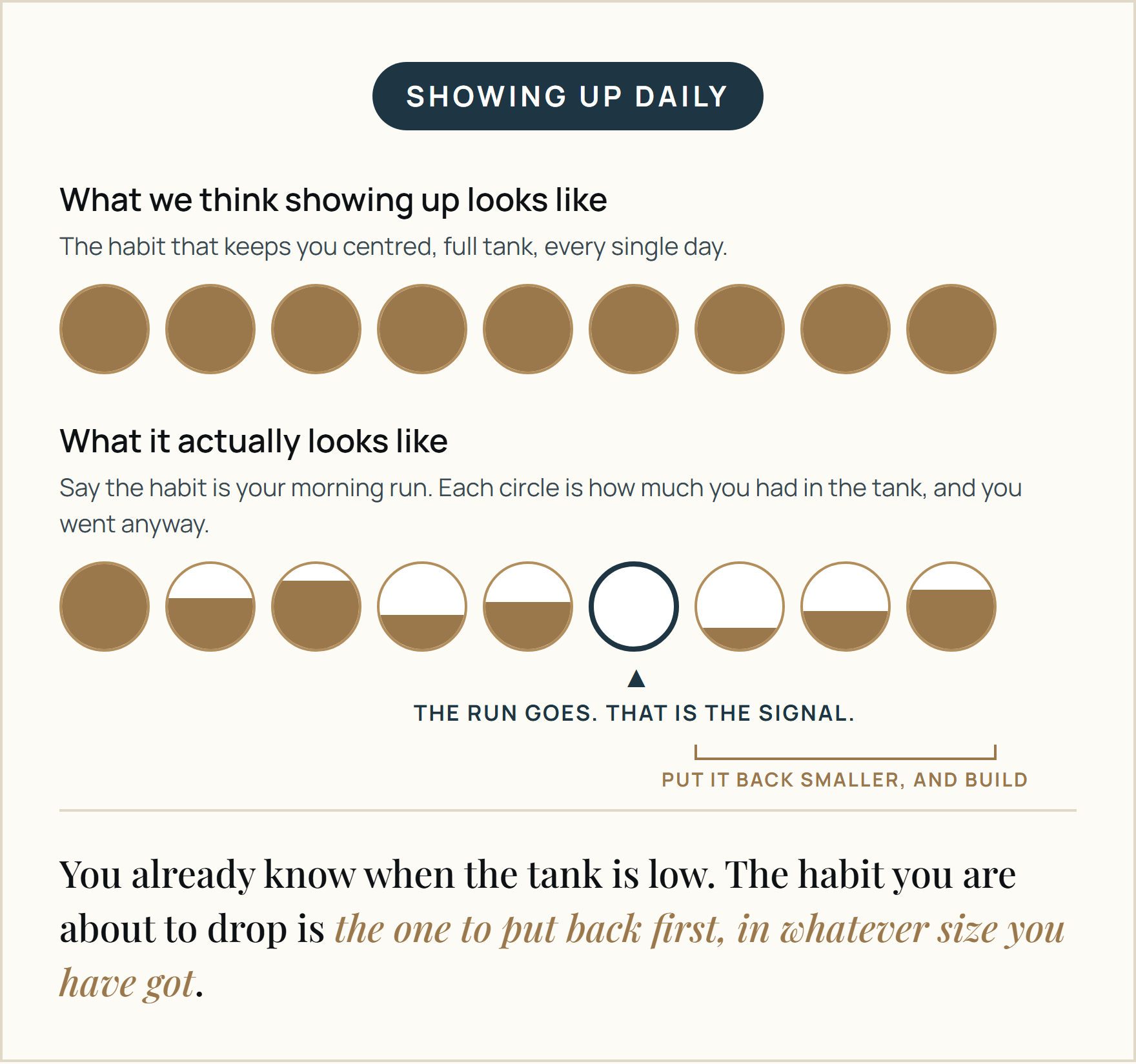
I wrote in Issue 03 that the gauge tends to fade exactly when you need it most. This is a version of that you can actually catch from the outside.
That is your cue to shake the snow globe.
Not necessarily to force yourself through the run anyway, but to ask what else is taking more from you than it should right now.
Perhaps the run doesn’t need to be the non-negotiable that day. Perhaps the non-negotiable is noticing that you’re about to give it up and then keeping some version of it in place.
Keeping some version of it in place usually looks like one of these.
- Walk instead of run.
- Do twenty minutes instead of an hour.
- Move a meeting.
- Push a deadline if it can move.
- Make dinner incredibly simple.
Because if you are genuinely depleted, adding more load in the name of discipline probably isn’t the answer. You can keep the general shape of the habit without pretending your capacity is exactly the same every day.
In practice
What this looks like for me right now
I’m training for HYROX in February 2027 in addition to all the other hats I wear. Every weekday I alternate between running and resistance training. It’s partly physical, but it’s also my mental health strategy. Right now, it also gives me something I can “win” at while other parts of life and business feel more complicated.
So when I wake up more tired than usual, or notice myself questioning the session, I try to ask:
What is taking more from me right now, and why is this the first thing I’m willing to give up?
Then I clear what I can. I move a few meetings. Shift a deadline if it can move. Put something in the crockpot. Accept that dinner might be avocado on toast… for the whole family. Or, now that my bigger kids are older, ask them to cook (including going to the supermarket for the ingredients, if needed).
In this case, accept that the original newsletter I had been working on for this week (about the biology of comparison) still isn’t good enough and I don’t currently have the capacity to get it there. So I wrote a different one.
Which is exactly what you’re reading.
The part I keep relearning
Keeping the general shape of a healthy life, while letting the detail bend when it needs to, is probably far more useful than pretending consistency means doing exactly the same thing regardless of what else is going on.
I am respecting my biology when I do that. It is telling me something.
I used to think about the body almost as a vehicle for the mind, something that carried the important bit around. I don’t think that anymore.
The body isn’t carrying the thing doing the thinking. It is part of the thing doing the thinking.
And even if it were only the vehicle, I’d still service it.
I’d love to hear from you. What is the first thing that usually goes when things start to unravel in your life? Just hit reply.
The other signal
The Capacity Wheel is a read on which way your wheel is turning, and on how much you have to spend before you ask yourself to spend it. About three minutes. It is a mirror, not an assessment.
Which way is your wheel turning?
The moment we most need the habits that keep us centred is often the moment we start dropping them.
This is Issue 09 of The Biology of Leadership, a weekly note written while I work on Beacon, a book on the biology of leadership. Subscribe here to get each issue a day before it appears on the journal.