The Biology of Leadership · Issue 02 · Sent to subscribers 29 July 2026
Here is a design flaw that has always bothered me. On the days you are most strung tight, most likely to say the thing you regret, some quiet voice should tap you on the shoulder and say “check in with yourself.” That is exactly the moment the voice goes silent.
The warning light dims as the danger climbs. This issue is about why, because once you see the machinery, the fix stops being “try harder to be self-aware” and becomes something you can build.
The insight this week
Your ability to notice you are depleted falls as you get more depleted
Here is the pattern I kept seeing in the interviews for the book. It is easy to spot your own burnout when you are not very burnt out.
The sharper shape of it: your self-awareness is inversely proportional to your depletion. Turn that around and it is almost hopeful. The calmer you are, the clearer the read.
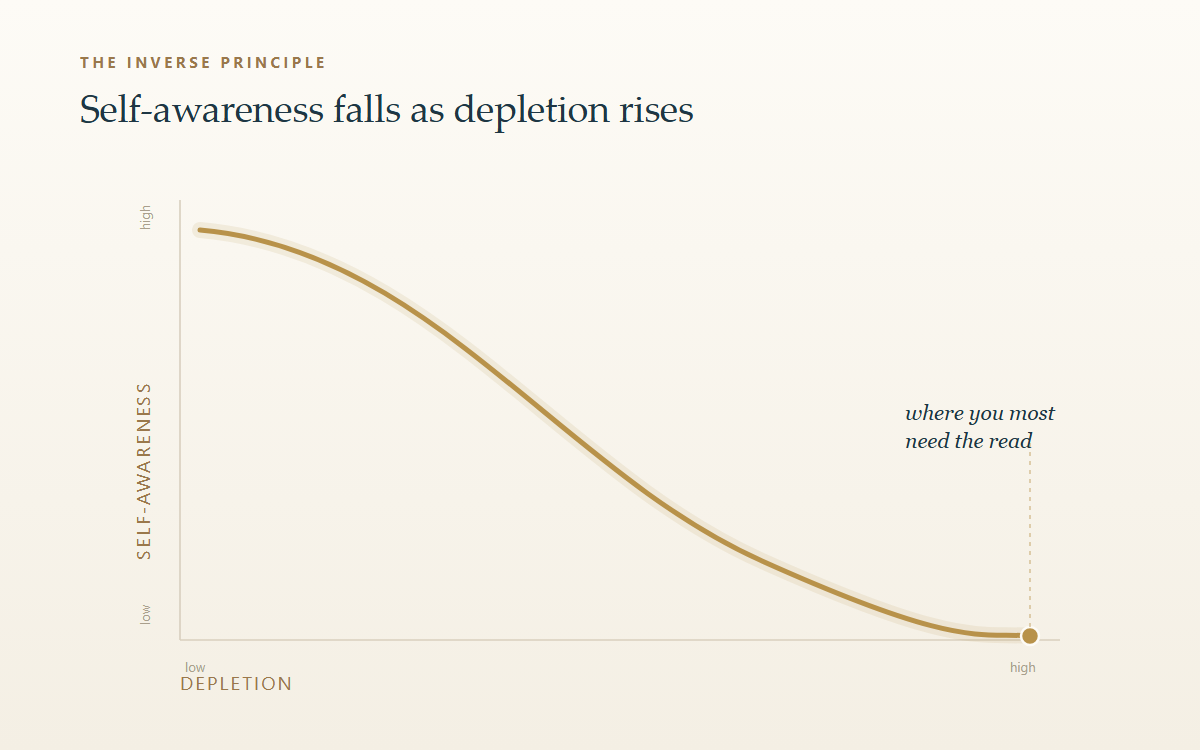
And note what kind of gap this is. Not a skills gap. These leaders read themselves well on a good day. It is a state gap. Same person, same skill, and the read goes as the state tips. So the question is never “do I know how to check in with myself.” It is “is my system calm enough right now to let me.”
The worse your state, the quieter the alarm that would tell you.
From the research
Why the alarm goes quiet exactly when you need it
Your brain constantly reads signals from inside your body, heartbeat, breath, the tension in your gut, and builds them into a felt sense of how you are doing. That is called interoception, and it is your warning light.
Then stress arrives. Adrenaline and cortisol are built for the threat outside you, not the check-in inside you. They quieten the prefrontal cortex, your self-monitoring and your brake, and push that inside read down the priority list. The light does not dim by accident. The system that runs it is the first thing stress switches off.
One of the leaders I interviewed for the book put it simply: “I had ignored all the signals. I’d reached my capacity, and I should have said, I have no capacity.” The signals were there the whole time. What failed was the reading.
The design flaw
The dim was built for a tiger, not a career
Your body was never designed for this. The dimming of your internal signal is meant to be temporary. It evolved for a short sharp threat, the predator in the grass. Go quiet inside, act, escape, reset. The light coming back on afterwards is the whole point.
Modern life broke that assumption. The threat now is the inbox, the quarter, the always-on, and it does not end. The reset never comes. The temporary dim becomes a permanent setting, and you start living in the dark without knowing it. Hold that long enough and you adapt to running dim, functioning on adrenaline and cortisol, quietly disconnected from your own state, until exhaustion forces the stop you would not choose.
The dim is a feature for a tiger and a bug for a career. The work is getting out of chronic resistance long before it tips.
The practice
You cannot will the light back on, so work upstream
You cannot decide to be more self-aware while the deciding part is the part being switched off. The lever is upstream, and two things move it.
Your baseline. The calmer your nervous system sits at rest, the more load it takes to tip you into the chemistry that shuts the light off. This is the unglamorous work, sleep, recovery, the nervous system getting regular evidence it is safe. It is also the highest return.
Training the observer. This is the heart of Sam Harris’s work in his app, Waking Up. His 30-day foundation course genuinely changed my life, and the lives of many of my clients. Open-monitoring meditation trains a quiet step back to watch your own state as it rises. Practised over time, the observer catches you even while you are activated, so you feel the thing rising while there is still a choice to make. It survives the load because you built it before the load arrived.
Why it matters at the table
Your most activated moments, the hard conversation, the bad number, the tense room, are the moments your state most shapes everyone else’s. They are also the moments you can least see it. Highest impact, lowest visibility, at the same time. A calm baseline and a trained observer are not soft extras. They are what keep the light on when it matters most.
See the state you bring
This is why I built the Capacity Wheel, and why it is free. It is an outside read on your state, useful precisely because your inside one gets unreliable under load. About three minutes.
Reply and tell me what landed. I read every one.
Rachel