The Biology of Leadership · Issue 03 · Sent to subscribers 5 August 2026
My 16-year-old son has been learning to snowboard. The first few times down the mountain he was nervous, so he went slowly. And going slowly made it worse. Anyone who has ridden a board or a bike knows why. Below a certain speed you lose stability. Slow does not necessarily mean safe. Slow means wobbling.
Then one run, it clicked. He came down grinning and said something I had to write down.
It’s okay to go fast, as long as I know how to stop.
He was talking about snowboarding but he had just described how to successfully ride the edge of capacity.
The insight this week
The problem was never the speed
We tell people to slow down. Do less, take it easier, protect your evenings. And it does not work.
Try it and watch what happens when you say it to someone. They give you reasons. The quarter, the team, the timing, the person who needs them on Thursday. It sounds like someone explaining why they do not want to. It is much closer to someone who has forgotten how.
Senior leaders are not short of information. They know exactly what they should be doing. However, they cannot do it from inside the state they are in.
Like my son on the board, going slowly costs them the very control they were trying to protect. The people who run companies are not looking for a gentler life. They are looking to go fast without coming off.
So the real question is not how fast you are going. It is whether your brakes work. And this is where the biology gets uncomfortable, because for the people who have the most drive, the brakes are the exact thing that stops working first.
From the research
Why caring about your work makes you fast
When you are chasing a goal, your brain runs a pursuit system. Its main chemical is dopamine. Most people think dopamine is the good feeling when something goes right. Nope. Dopamine is the chemistry of wanting.
Having purpose is not a mood. It is a drive, and it has a chemical fingerprint. That drive carries you past the point where you would otherwise stop. Noradrenaline works alongside it, sharpening focus and keeping you switched on. Under real pressure, cortisol and adrenaline pile in on top.
Your body does not draw a clean line between a threat you are running from and a mission you are running toward. Both pull on the same wiring.
And then it takes the brakes away
In Issue 02 I wrote that your ability to notice you are running low falls as you get lower. The warning light dims as the danger climbs. Here is what I did not say then.
Drive dims it faster. A brain locked onto a goal narrows to that goal, and the first things to drop out of view are the internal ones. On top of that, staying switched on releases your own painkillers, endorphins, which blunt discomfort so you can keep moving through it. It is the same reason a player does not feel the injury until the final whistle.
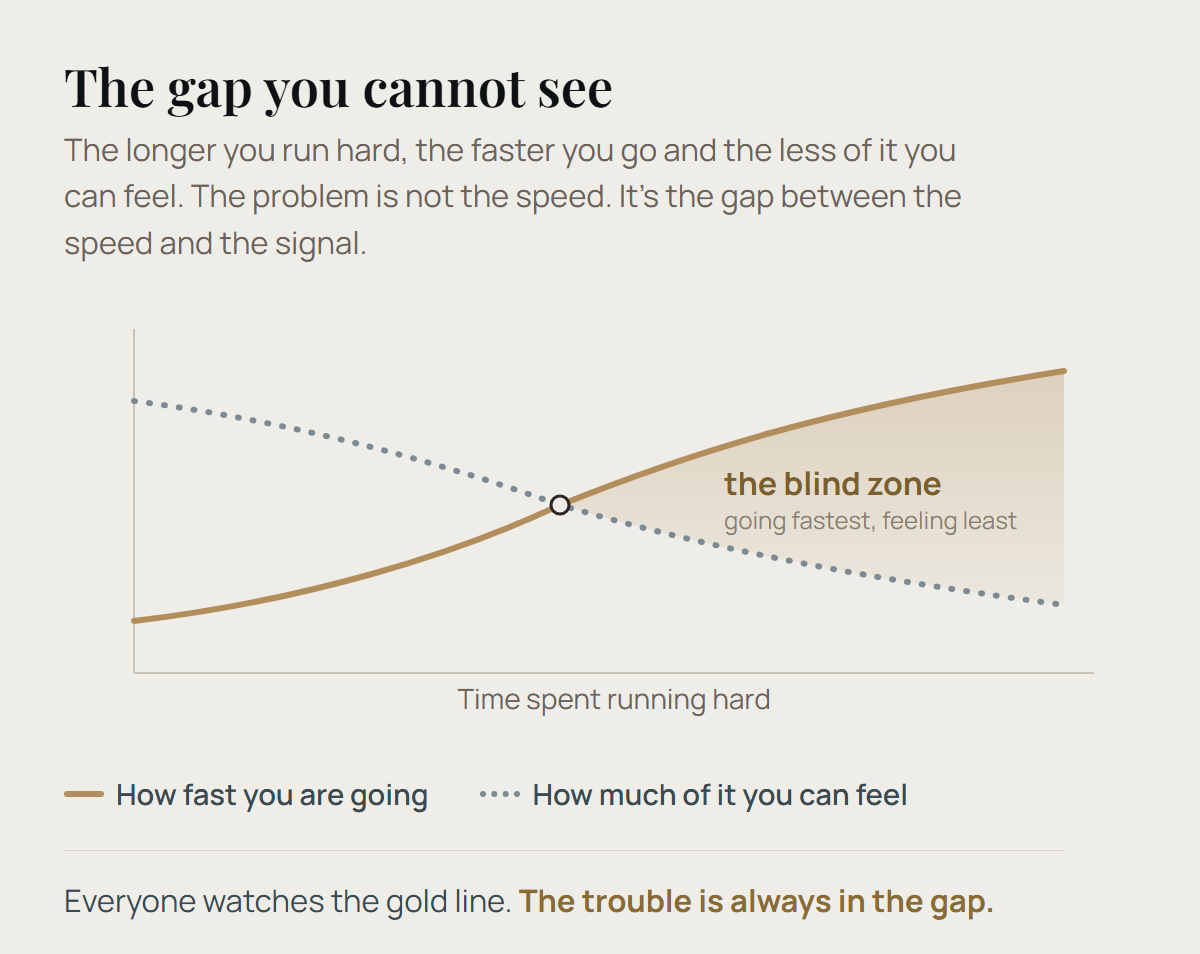
They are not pushing through the warning. The people who push past it have brain chemicals that have stopped them feeling it.
The people wired to drive hardest are usually the ones you promoted.
Then the organisation adds its bit. A company draws its output from the committed ones, so the work leans toward them. More lands on the desk that never says no. The reward for carrying the load well is a heavier load. Nobody plans this. It is just what any system does when it finds someone who keeps saying yes.
From the interviews
Almost none of them saw it first
Of the 26 senior leaders I interviewed for the book, again and again it was someone else who saw their depletion before they did. A partner, a spouse, their kids, someone on their team. Very few of them read their own decline first.
That is not an anecdote. It is the most consistent thing in the whole project.
And one of them put the trap better than any paper I have read.
When you’re fatigued, you sacrifice the very habits that recover you.
Let me repeat this. The brake is not just quiet. It is the first thing you throw overboard, right at the point you need it most.
The twist
Some people’s brakes are quieter than others
How hard your stress system fires, and how strongly your reward system pulls, differs from person to person, and a real part of that difference is inherited. Two people can carry the same load in completely different bodies. One runs hot, drives hard, and feels the tiredness late if at all.
That is not a willpower ranking, it is wiring. And if you know how you are wired, you can pull the brake earlier.
The practice
Build the brakes
So here is the most useful thing in this email for you. Ask.
Ask your partner. Ask the person who sees you at 6pm rather than 9am. Ask them straight: have you noticed me running low, and when did it start? You will not like the answer, because they will have seen it before you did. That is exactly what makes it worth having.
They are not offering an opinion about you. They are reading an instrument you cannot see.
All you have to do is ask them, and then believe them.
How you lead your people: the person to check on is the one you worry about least. Not the one who looks stretched, the one who never does. Ask them what they have said yes to in the last month and count it out loud with them. They will not have counted.
The admission
I have been on the other side of this
Six years ago I was the client, in a nascent version of what became our keystone program. My specialist told me the diagnostics were showing a body under real strain. My resting heart rate and my heart rate variability had both been moving the wrong way for weeks. I had a ring on my finger recording all of it, and I had not felt any of it.
She suggested I swap the runs and the resistance training for a walk.
I had what I can only describe as an allergic reaction to the idea. No. Not walking. That is not how my stress management works.
And here is the part I am least proud of and find most useful. I agreed, and then I negotiated. I would walk, but at pace. I could accept the brake, but I resisted pulling it.
You cannot fix this by trying harder to notice, because noticing is the thing that has been switched off. You need a brake that sits outside your own head. A number, a person, a fixed check-in. Something that does not dim when you do. Ask them, believe them, and then have one non-negotiable habit you do to force the stop, or at least a slow down, the moment that signal appears.
It is okay to go fast. You just have to know how to stop.
A brake that sits outside your own head
The Capacity Wheel is a read on which way your wheel is turning, from outside the head that has stopped feeling it. About three minutes, and it does not dim when you do.
Which way is your wheel turning? →
Rachel Taylor, MSc(Hons) writes The Biology of Leadership while completing Beacon, a book on the biology of leadership. Subscribe for weekly insights.