The Biology of Leadership · Issue 06 · Sent to subscribers 26 August 2026
One of the leaders I interviewed is one of the most commercially successful people I have spoken to. He built a company from scratch and put its work in front of millions a year. Warm, funny, full of energy.
One day a trusted colleague sat him down and asked whether he knew he was often a bully.
He said what most of us would say. What? I’m not a bully.
Then his colleague explained it. You walk into a room with all this energy and this belief that something can be done. What you are forgetting is that the room is full of people who do not have that confidence. They cannot see the path as clearly as you can. So what they hear is that this must be done, and they are too frightened to say it cannot be.
What struck me most was his answer. He had expected people to argue back and tell him he was wrong, and he meant it. But if someone had pushed, I suspect it would have landed as dismissal rather than debate.
I assume his colleague meant that form of bullying. Making people feel like they are going mad. That their opinion does not count. That a doubt cannot be raised without being overridden.
I told him the theory I had been toying with. That leadership is environmental design, that you bring the weather with you whether you mean to or not.
Then, a few seconds later, he said this.
I wasn’t just the weather. I was the storm.
He did not need persuading. He needed the words for it.
The insight this week
Forecasting a leader is a hidden cost
A team that cannot predict its leader keeps a system running all day. Reading the room before speaking. Timing a request for the right hour. Working out whether today is a day you can raise the difficult thing, or a day you carry it for another week.
That is real work. It never appears on anyone’s list of what the week cost.
And it comes out of the same budget as the job. There is no separate reserve for surviving your boss. The watching is paid for with the energy that was meant to go into the work.
This is a very real, very erosive business problem.
From the research
Your team is running threat detection, and it does not switch off
As I covered in issue 01, that is a nervous system doing its job. We grew up in groups where belonging kept you alive, so the human brain checks for threat many times a minute, mostly without you noticing. Most of what it checks is social. Is this safe. Am I still in favour. What is the face at the front of the room doing.
That system is cheap in short bursts and expensive when it never stands down. It takes attention first, then memory, then the willingness to say the hard thing out loud.
From the interviews
They will spend time reading the weather rather than doing the job
Another leader told me her own tell. When she is under it she goes very quiet, and then a little bit snappy, and it is so unlike her that people notice straight away.
I can see it on their faces, and it’s like they almost sit back, because they’re not used to it.
She can watch her own weather land on other people. Then she told me what she does about it.
If I want them to do their best work, I want them to be in the right space and not worry about all this craziness going on, because then they’ll fill the vacuum. They’ll spend time reading the weather rather than doing the job.
That is the whole argument, and it is hers rather than mine. A team with an unreadable leader does not stop working. It starts doing a second job on top of the first one.
Leading, she said, is like building something enclosed and keeping the conditions steady inside it on purpose, while the real weather carries on outside.
Above her, getting buffeted: the storms she does not control and cannot stop. Decisions made over her head. Her own boss under pressure. She is reading that weather too.
Below her, setting the weather: the conditions she builds for her team on purpose, so they can get on with it. Deliberate, and it is work. It is why they are not guessing. Nobody sees her doing it.
That work is invisible to everyone, including the people it protects.
The twist
You are reading this from both ends of it
Most of us are somewhere between them, and doing both directions at once. The morning you spend working out what mood your chief executive (or chairperson) is in is the same morning your own team spends working out what mood you are in.
That is a tough spot to be in, and it is also the good news. You already know what this costs, because you have felt it from underneath. You do not need convincing that it is expensive. Only that you are also a source of it, and that you cannot feel your own weather. Same blind spot as the warning light that dims as the danger climbs.
What to say
You cannot always order the weather. You can publish the forecast.
After all these conversations, I think I have found the system underneath it.
Leadership capacity turns on four things. Your biology, your leadership, your behaviour and your environment. Your body is the instrument you play all of them on.
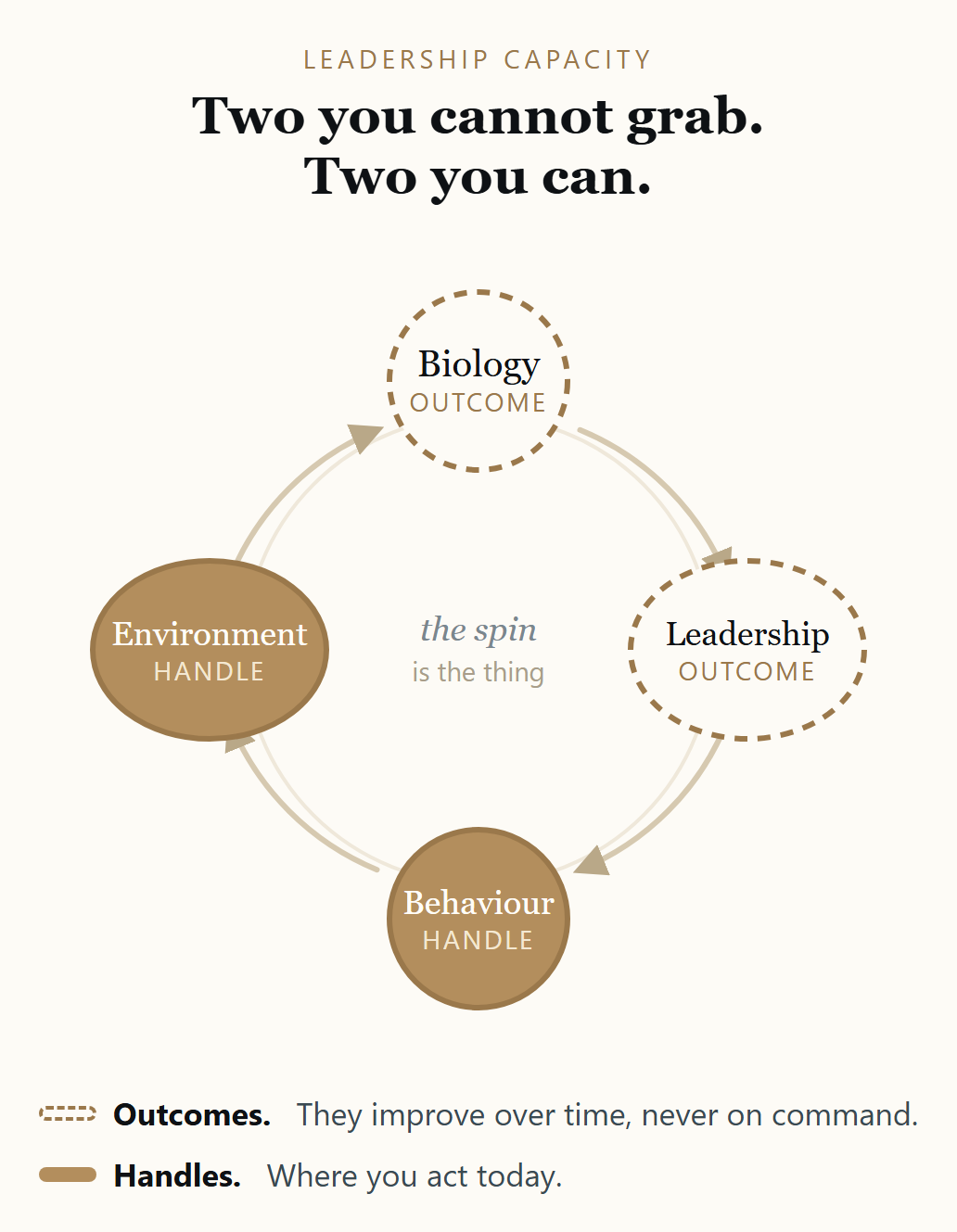
The outcomes, biology and leadership: the music your instrument makes. They do improve, through the handles and over time. What they will not do is take an order in the moment. You cannot decide to have better biology. You cannot force a wise call out of an empty tank, even when you know better. You can learn to lead better, and still not summon it on a flat day.
The handles, behaviour and environment: the parts you can put your hands on today. What you actually do. The room you set for other people. The only two that touch anyone else, which is why this is where you push.
But you can get better testing to see what is actually happening in your biology, and that tells you where to aim the handles. The handles are still what move.
Trying to be in a better mood when you are depleted will often fail, because moods are not that obedient. So the practice is to publish the forecast.
The next fortnight is going to be ugly, this is why, and this is when it ends.
I am running on very little this week, so push back harder than usual if I sound certain.
That costs almost nothing to say, and it hands the watching budget straight back to the room. People do not need their leader to be always sunshine and rainbows. They need to know what is coming so they can stop spending energy guessing at it.
If you lead people, say the forecast out loud when things are fine, not only when they are not.
If you report to someone, you are already forecasting them. The question worth asking is what that costs you, and whether the person above you has any idea you are having to do it.
What to do about it
The ones who cope best decided in advance
Almost every leader I spoke to had something they do. Step outside. Get some air. Walk around the block. Box breathing in the car before they go in.
The specific thing barely matters. What matters is that they picked it before they needed it. If this happens, I do this.
This is load management. In the moment the weather arrives you have the least judgement available, and a routine means you are not spending any of it deciding what to do. The decision was already made on a better day.
This is also where the wheel stops being a diagram and starts being useful. Something external happens, and it trips one of the two handles you actually own. Your behaviour, or the room you put yourself in.
Scenario planning
Decide it now, while you still have the judgement to decide it well.
- The board meeting runs hot → Ten minutes outside before the next one
- You wake at 2am solving it → Get up, write it down, go back to bed
- Three back-to-back calls → Walk the block before the fourth
- You can feel yourself getting short → Say the forecast out loud, then take five
Your list will look nothing like this one. What matters is that you wrote it on a good day, so the depleted version of you does not have to decide anything.
One more thing
Sometimes there is something actually wrong inside
There is one thing I have left out. Sometimes the problem is not the forecast at all. Maybe you are depleted of iron, or another vitamin or mineral that matters. Maybe your gut is messing up your brain chemicals. Maybe your own genetics mean overthinking is far and above what others experience.
There might be a reason you are still struggling with all of this, and it is not willpower.
If you keep hitting a wall at 3pm, if your mood shifts two or three times before dinner, if you are wide awake at 2am or hungry again an hour after lunch, that is the Metabolic Profile. Two weeks wearing a continuous glucose monitor while you eat the way you normally eat, so you can see which meals give you energy and which ones quietly take it.
If you are tired and wired at the same time, if you get eight hours of sleep and wake as though you had none, if some weeks the energy is there and some weeks it is gone, that is the Executive Uplift Program. Bloods, wearables, your history and a genetic analysis of how you handle stress, recovery and caffeine, so you can stop guessing.
And if you were one of my interviewees, I am invested in you. I will cover the genetics interpretation free of charge.
The other signal
The Capacity Wheel is a read on which way your wheel is turning, and on how much you have to spend before you ask yourself to spend it. About three minutes. It is a mirror, not an assessment.
Which way is your wheel turning?
A team that cannot predict its leader does not stop working. It starts doing a second job on top of the first one.
This is Issue 06 of The Biology of Leadership, a weekly note written while I work on Beacon, a book on the biology of leadership. Subscribe here to get each issue a day before it appears on the journal.