The Biology of Leadership · Issue 07 · Sent to subscribers 2 September 2026
It’s a windowless room. The lights are on because they have to be. There’s a bowl of sweets in the middle of the table and somebody keeps refilling it.
I’ve sat on a number of boards. I want to describe one in particular, because the same thing happened at every meeting. It was a large organisation, doing work that mattered here and overseas.
We sat down at nine and we tended to stay down until lunch, barring a quick toilet break.
I was the youngest director in that room by a distance. I stood up occasionally. I stretched, because I knew it mattered. Mostly I watched the room.
Nobody else moved.
Coffee came as we arrived. More at half ten. Then again straight after lunch, and another round at two.
Then lunch, which is an event of its own. If you have dietary requirements it’s complicated before it starts. But the real problem was what arrived. It was beautiful. Someone had gone to genuine trouble.
And if you sat down and deliberately designed the food least likely to help a person think clearly through a hard afternoon, that was it. Every single time.
At one meeting I offered to work with the team on the food. They took me up on it.
So I made sure there was enough protein, mostly animal based, with proper options for the vegetarians. Fats that do something. Carbohydrates that release slowly instead of all at once. And I asked for the sweets to come off the table and be replaced with a nut and seed mix. Not ideal. Better.
As this particular meeting wrapped up, one of the board members said this to me.
That was a great meeting. Did you have something to do with the food today? That was really good.
He had not been told anything had changed. He noticed the day, and worked backwards to the food.
Clearer heads. Sharper answers. Less arguing. And the day seemed to disappear rather than drag. I did notice that the nuts stayed on the table from then on.
The insight this week
A room is one of the two things you can actually take hold of
Last week I showed you the capacity wheel. It came out of the interviews.
The way I see it, there are four parts to how much capacity a person has. Biology. Leadership. Behaviour. Environment. Capacity is the wheel turning.
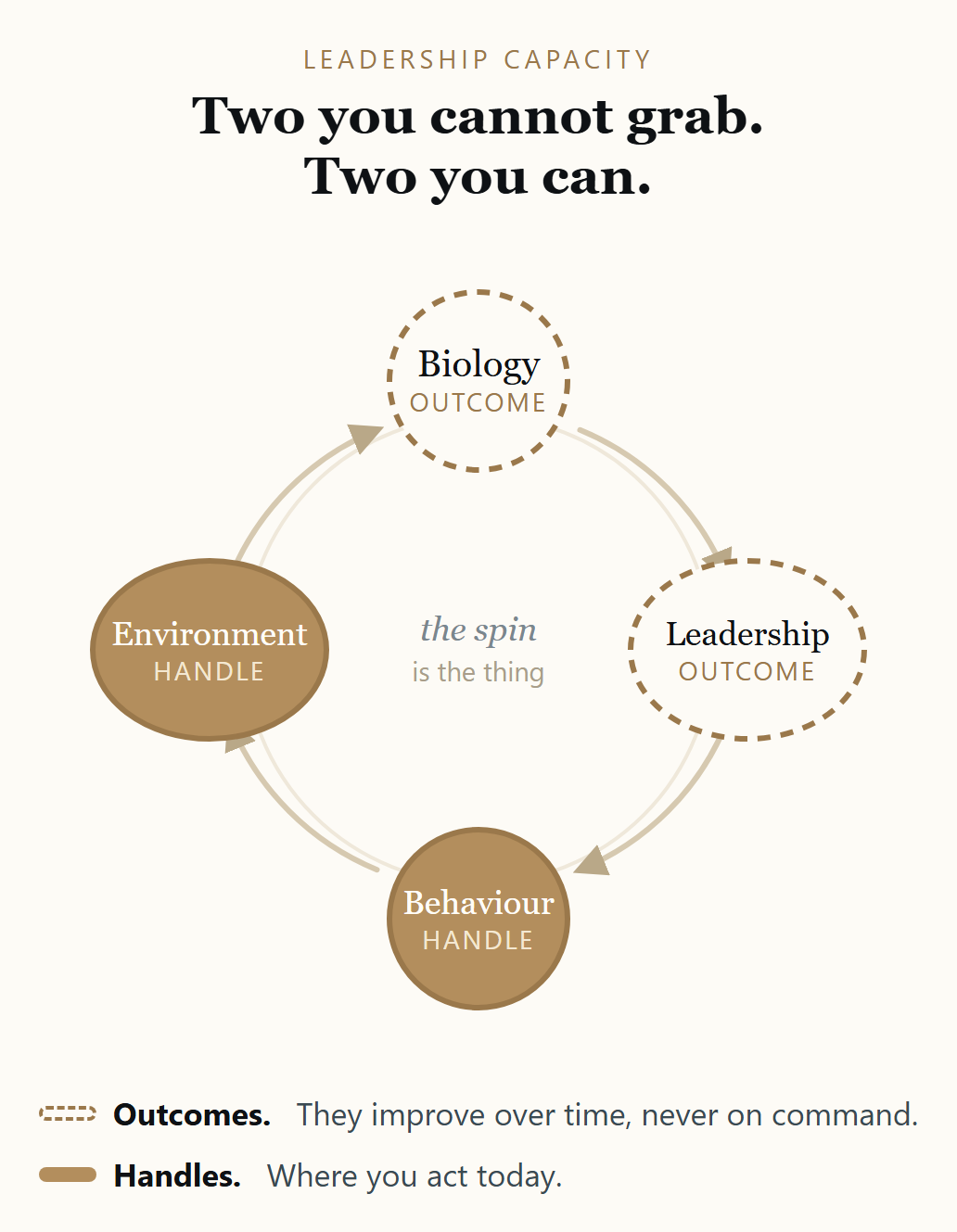
You cannot decide to have steadier bloods. You cannot conjure two years of experience as a chair in the moment you need it. Those move over time, and never on command. What you can change today is what you do and the room you do it in.
Back in the room
Nutrition sits in the environment, because nearly everything you eat here was decided by somebody before you got hungry. Grabbing the food sits in behaviour, because that bit is still your call.
The board day is an environment. Six hours of one, and every part of it was chosen by somebody.
Look at the care that goes into the rest of it. The pack arrives in a confidential board app behind several layers of security.
And that’s just the papers. Somebody booked the flights. Somebody chose the caterer and signed off the menu. Somebody arranged the dinner the night before and worked out who sat next to who. Somebody picked the guest speaker and decided how long they get. Every one of those had a name against it and a budget.
Nobody was asked what all of it together would do to the people in the room. Nobody owned whether those people could still think clearly by the middle of the afternoon.
Not neglected. Unowned. There’s no line anywhere saying whose job it is, so it’s nobody’s, so the day runs on default. Whatever was done last time gets done again. That is what default looks like from the inside. It doesn’t announce itself as a decision. It just looks like normal.
Putting a day like that together is a full time job, usually done on top of another full time job. The care was real. It went into the papers and the logistics. It never got as far as the people’s ability to make better decisions.
From the research
The room hands you the cure for the harm it’s doing
The food was the part I could see. So I went looking for the rest of it. Here’s the day, in order, and it starts earlier than nine.
- 7am. Half that room flew in. Airline snack, and a Cookie Time handed round, because that is what gets handed round.
- 9am. Everyone sits down. Almost nobody stands up again until lunch.
- 12:30. Lunch arrives. Little bioavailable protein, mostly from plants that drive inflammation, and plenty of starch. Blood sugar climbs, then drops.
- 1:30. An hour later you want something. Something is right there in the middle of the table.
- 2pm. You reach for the coffee. It covers the last hour without putting anything back.
- 2:30. Half the room is thinking about a flight or the drive home.
- 3pm. The tail of the agenda, the item pushed from earlier, gets decided.
I cannot tell you who ate what. I can tell you that was the choice on offer, both in the room and before anyone had reached the building.
Meanwhile nothing in the day has asked anyone to move. A still body moves less blood and breathes shallower. So the organ doing the thinking is getting less oxygen, on top of whatever your blood sugar is doing.
The coffee leaves you wired on top of empty. Caffeine makes the body less sensitive to insulin for a few hours, so a coffee on top of a meal makes that meal’s rise bigger and longer than the same meal without it.
The sweets are on the table because people crash. The coffee comes round because people crash. Both are acts of hospitality. Somebody put them there to look after you.
The room makes the crash. Then it hands you the coffee and sugar. Rinse and repeat.
From the interviews
One leader watches it happen from across the table
One of the leaders I interviewed sees this from the other side of the table.
He goes to the business breakfasts and the lunches. He watches people eat and drink, and then he watches the energy go out of the room. Not one person. The room. It’s a two hour event, three at most, and the energy is gone well before the end.
These are people he respects. People he has time for. And the thing he finds himself thinking, sitting there watching it, is this.
My gosh, how do you cope on a day-to-day basis when your energy kind of looks like it’s absorbed in about an hour and a half and it’s gone?
He doesn’t say it in the room.
He doesn’t blame anyone for it either. He told me this simply isn’t well known, not in the circles he moves in anyway, and that people just don’t know.
That’s the part I keep coming back to. Everyone in the room is blissfully unaware of what it’s costing them. There is nothing blissful about the cost.
The twist
The room isn’t the cause. The room is the sample.
The people around that table are mostly career board members, or senior executives somewhere else in their own right. So this isn’t one random Thursday. It’s every board they sit on, every offsite, every conference, every industry lunch. Same room, same table, same food, for twenty years.
That matters, because the biology changes when you go from one afternoon to two decades. A single bad lunch is a blood sugar story. Twenty years of them negatively impacts the gut.
Your gut has its own nervous system, and the traffic between it and your brain runs mostly upward. It’s reporting to you far more than you’re instructing it, and those reports land where you get your felt sense of how you’re doing. Gut instinct isn’t a metaphor. It’s a body report shaping a judgement before you can explain it.
Board members are paid for that judgement.
There were a few people around that table who genuinely look after themselves. Who care for the instrument. They were still in the same room eating the same food, because that’s what was there.
After a few meetings I started bringing my own snacks.
The environment is stronger than the intention. It often beats the person who knows better, unless they design their own.
What to do about it
The cheapest lever in the building
Nobody in that room could have willed their way out of the dip. Trying harder was never going to work. Changing the room would have, and any one of them could have done that. It is the cheapest lever in the building.
If you run these days, or have a say in how they run, here are four things. None of them cost more than you’re already spending.
Four things, none of them expensive
- Put adequate protein and fat in the lunch and let the carbohydrates be the slow kind. People come back able to think.
- Take the sweets off the table and put nuts and seeds there instead. Even better? Biltong or something with protein. Ketone-based smoothies if you really need the team to turn all the lights on. You’re not policing anybody. You’re designing what’s on the table.
- Build movement into the shape of the day rather than hoping people take it. If standing up looks like a statement, nobody will. Interrupting long stretches of sitting with even a short walk measurably lowers the rise after a meal.
- Put the hardest item before lunch. Not after, and never last. Last is where it usually ends up, and last is a depleted room with one eye on the exit. If you only do one of these, do this one. It costs nothing.
That’s the handle. Left alone, the day runs on default, and the default turns that wheel the wrong way. That is the last thing you want in a room making big decisions. It’s the one part of the wheel you can turn this week, on somebody else’s behalf, before anyone in the room has to be disciplined about anything.
One more thing
Treat them like the athletes they are
These are the people the whole organisation is arranged around. Their judgement is the product. And on the day that judgement matters most, we put them in conditions no athlete would accept for a single afternoon.
Nobody would take a professional team, sit them in a windowless room from nine until three, feed them sugar throughout the day, hand them multiple coffees, and then ask them to make the biggest call of the day. We’d find that absurd. We do it to boards every week.
I’m not asking anyone to change their life. That isn’t the point.
The point is the body you arrive in. It’s the vehicle. It’s the thing doing the thinking, holding the attention, reading the room and making the important calls. Everything a board pays for comes out of it.
Most of us run that vehicle like a battered old Camry. Whatever fuel is nearest, servicing when something rattles, and then we’re surprised when it struggles up the hill.
It doesn’t have to be a Formula 1 car. A Lexus would do. Good fuel, on time. A body that has moved. A room that isn’t quietly working against the person sitting in it.
Do that for one day, in one room, and you get a different set of decisions out the other end.
Designing the room
We have been designing rooms for a few years now.
On one event we put continuous glucose monitors on 90 attendees. We watched the first day. We could see the room, when it dipped and what put it there. Then we built the next day around what we saw, and people stayed alert and stayed with us.
It is part science and part craft. Mostly it is just somebody paying attention to what the room is doing to the people in it.
If you are running a board day, an offsite or a conference this year and you want it designed rather than defaulted, there is more about how we do it on the events page.
The other signal
The Capacity Wheel is a read on which way your wheel is turning, and on how much you have to spend before you ask yourself to spend it. About three minutes. It is a mirror, not an assessment.
Which way is your wheel turning?
Every part of that day was chosen by somebody. Nobody was in charge of what all of it did together.
This is Issue 07 of The Biology of Leadership, a weekly note written while I work on Beacon, a book on the biology of leadership. Subscribe here to get each issue a day before it appears on the journal.